
I. Introduction: Behind Every Great Smoke — A Great Factory
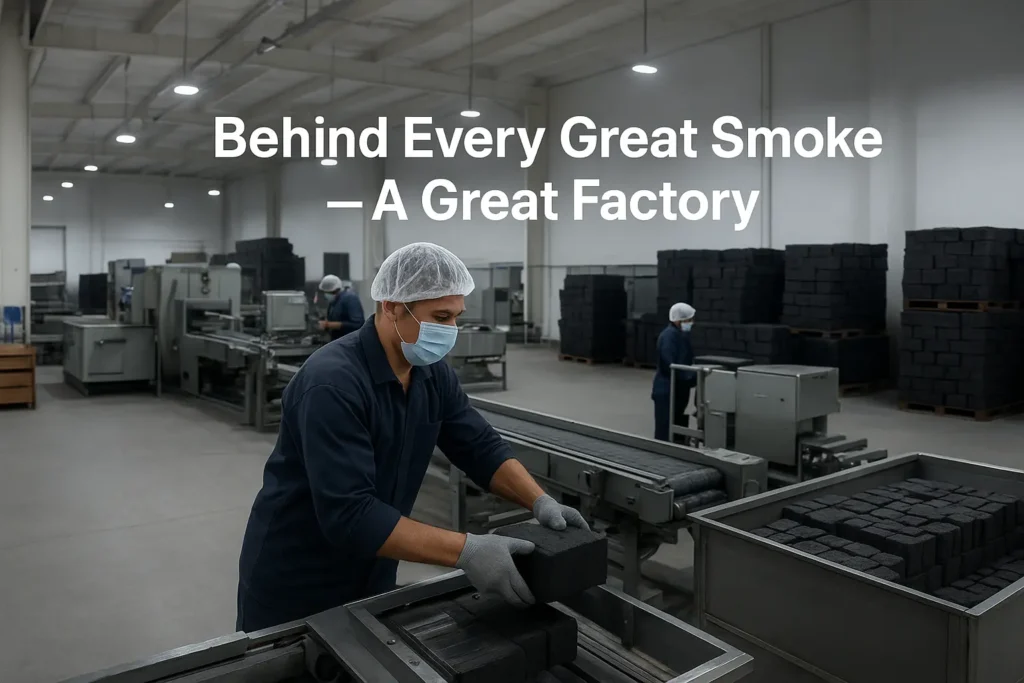
bintangbriquettes.com – In the world of shisha, every smooth puff, every thick cloud, and every moment of perfect heat control comes down to one essential element — the charcoal.
But behind every great charcoal lies something even more important: a great factory.
A Shisha Charcoal Factory is not just a place where coconut shells are turned into briquettes — it’s the heart of consistency, quality, and performance. It’s where precision meets craftsmanship, and where small differences in process can completely change the smoker’s experience.
From selecting the purest coconut shells to mastering the carbonization process, every step taken inside a professional factory determines how well your charcoal will burn, how long it will last, and how clean your smoke will be.
Whether it’s for high-end lounges in Dubai or home users in Berlin, the reliability of a shisha charcoal brand always begins at the source — the factory itself.
Unfortunately, not all factories operate with the same care and standards. Some focus purely on quantity, while others — like premium producers — prioritize quality control, environmental responsibility, and customer trust.
That’s why understanding what defines a reliable Shisha Charcoal Factory is crucial for importers, distributors, and even everyday users who want the best smoking experience possible.
In this article, we’ll uncover the key standards that separate a dependable factory from the rest — from raw material selection and production technology to sustainability and international certification.
Because when it comes to shisha, quality isn’t a coincidence — it’s a result of how your charcoal is made.
II. Understanding What a Shisha Charcoal Factory Really Does
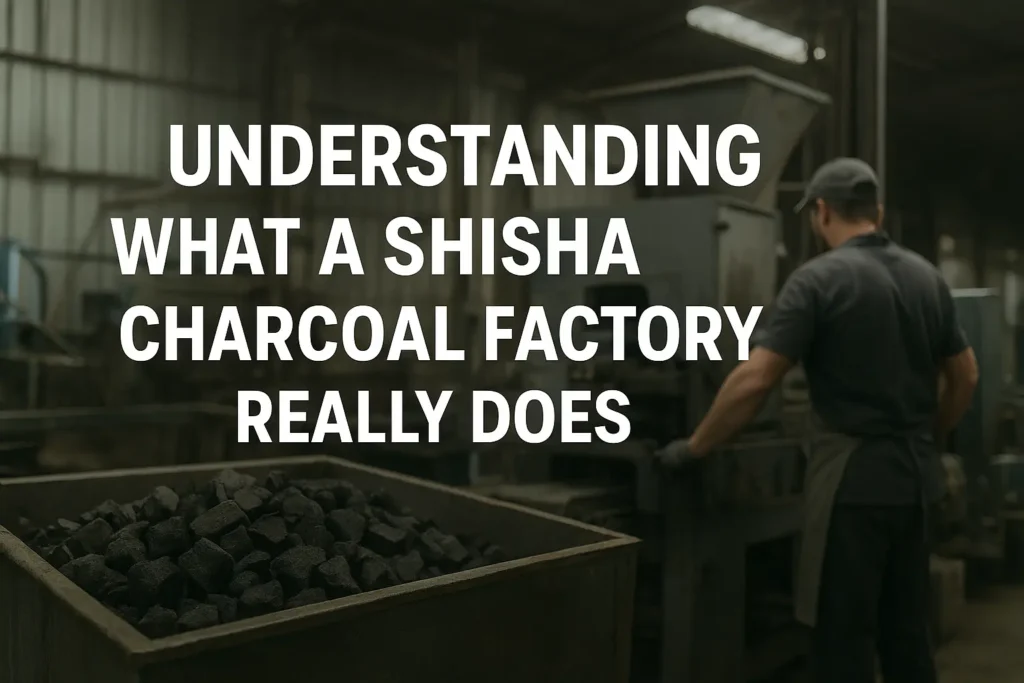
At first glance, a Shisha Charcoal Factory might seem like just another manufacturing plant — where raw coconut shells go in, and finished briquettes come out.
But in reality, it’s a highly technical, multi-stage process that blends science, precision, and experience to achieve charcoal that meets global quality standards.
🔥 1. From Coconut Shell to Charcoal
The journey begins with selecting the right type of coconut shell — mature, hard shells with minimal moisture and high density. These shells are then carbonized at controlled temperatures to create charcoal with a rich carbon content and minimal impurities.
The carbonization process determines everything: burn quality, ash color, density, and the overall purity of the final briquette.
⚙️ 2. Grinding, Mixing, and Molding
Once carbonized, the charcoal is ground into fine powder and mixed with a natural binder (usually tapioca starch). This mixture is then molded into cubes, hexagonal sticks, or other custom shapes depending on market preference — whether for shisha lounges or BBQ consumers.
🌡️ 3. Drying and Heat Treatment
The molded briquettes go through a drying chamber or oven, reducing moisture content to below 6%.
This stage is critical — if moisture remains too high, the briquettes will hiss or crack when lit. A well-run Shisha Charcoal Factory maintains precise humidity and temperature control to ensure consistent drying results across every batch.
🧪 4. Testing and Quality Control
Every reliable factory performs a series of laboratory and burn tests to measure:
- Ash content
- Burning time
- Caloric value
- Moisture percentage
- Volatile matter
Only batches that meet the required specifications move forward for packaging. This guarantees that every briquette performs predictably — delivering the same heat and duration every time.
📦 5. Packaging and Export Readiness
Finally, the finished briquettes are packed in inner boxes and master cartons that are moisture-proof and designed for export durability.
A professional Shisha Charcoal Factory ensures every carton is labeled with production details, batch numbers, and country of origin — essential for quality tracking and import documentation.
In short, a shisha charcoal factory isn’t just about production — it’s about consistency, traceability, and precision.
The more refined the process, the better the product quality and the stronger the brand reputation in international markets.
III. Key Standards That Define a Reliable Shisha Charcoal Factory
A Shisha Charcoal Factory is only as good as the standards it upholds.
Buyers, especially from Europe and the Middle East, now demand not only good performance but also consistency, safety, and sustainability.
Here are the key standards that separate a reliable manufacturer from the rest.
🌴 1. Raw Material Selection
A premium factory always starts with 100% natural coconut shells — no wood, no additives, and no fillers.
The best shells come from mature coconuts with thick, hard husks that produce dense, long-burning charcoal.
Factories that buy mixed materials often struggle with unstable burn times and excessive ash — a major red flag for serious buyers.
⚙️ 2. Production Consistency
Reliable factories maintain strict temperature and moisture control during carbonization and drying.
This ensures each batch has the same burn quality and heat output.
Consistency is what global importers value most — knowing every container they order will deliver the same performance as the last.
🧪 3. Lab Testing & Quality Assurance
Top factories perform regular lab analysis for moisture, ash, volatile matter, and caloric value.
Certificates of Analysis (COA) are issued for every shipment — proving that the charcoal meets export-grade standards.
This transparency builds trust and strengthens long-term partnerships with importers.
📦 4. Packaging Standards
Packaging is more than presentation — it protects the product.
Reliable factories use moisture-proof inner boxes and strong export cartons.
They also provide custom branding and labeling options for private labels, ensuring the charcoal arrives in perfect condition even after long-distance sea freight.
🌍 5. International Certification & Compliance
Factories that export to demanding markets like Germany, Saudi Arabia, or the UAE must comply with international safety and quality standards.
This includes:
- ISO-certified production processes
- Fumigation and phytosanitary certificates
- MSDS (Material Safety Data Sheet) documentation
These certifications prove that the factory operates with professionalism and global accountability.
💨 6. Environmental Responsibility
A responsible Shisha Charcoal Factory doesn’t just make good charcoal — it also respects the planet.
Modern factories use eco-friendly kilns, smoke filters, and sustainable raw material sourcing.
This reduces carbon emissions while ensuring that the charcoal remains 100% organic and renewable.
A factory that meets all these standards isn’t just producing charcoal —
it’s producing trust, quality, and reliability that global importers can depend on for years to come.
IV. How to Identify a Trusted Factory When Buying for the First Time
If you’re sourcing from a Shisha Charcoal Factory for the first time, it’s easy to be overwhelmed by countless suppliers claiming to offer “premium quality.”
But not all factories deliver what they promise. To avoid costly mistakes, here’s how to identify a truly reliable and professional charcoal manufacturer.
🏭 1. Request Factory Photos and Production Videos
A legitimate factory is transparent about their process.
They’ll gladly share videos showing carbonization, briquette pressing, drying, and packing.
If a supplier avoids showing their facilities or only sends stock photos — that’s a clear warning sign.
Tip: Ask for a video call from the factory floor. It’s the easiest way to verify authenticity.
📋 2. Ask for Technical Data Sheets (TDS) and Certificates
Every reputable Shisha Charcoal Factory should be able to provide:
- Moisture Content Report (≤6%)
- Ash Content Analysis (≤2.5%)
- Volatile Matter Level (≤15%)
- Caloric Value Test (7,500–8,000 kcal/kg)
Factories that provide official lab results show they have consistent quality control — not just marketing claims.
🔥 3. Check the Charcoal’s Physical Characteristics
You can learn a lot from how the charcoal looks and feels:
- Surface: smooth and dense, not porous or cracked
- Color: deep black matte finish, not grayish
- Weight: heavy for its size — indicating high density
- Burn: long and even, with low ash residue
Always request samples before bulk order to test burn time, ash color, and stability yourself.
🌏 4. Evaluate Export Experience
Factories with a strong export record have established procedures for documentation, fumigation, and container packing.
Ask which countries they export to and for how long they’ve been in operation.
Factories exporting to Europe or the Middle East typically maintain higher quality due to stricter importer requirements.
💬 5. Transparent Communication
Good communication reflects good business ethics.
A reliable factory replies promptly, explains their process clearly, and provides honest lead times.
If responses are inconsistent or evasive, it’s better to move on before you risk delays or poor quality.
💡 6. Visit or Appoint a Local Inspector
If possible, schedule a visit or hire a trusted local inspection company.
Seeing the production firsthand — or having a third-party report — can save you from fraud and ensure the factory truly operates as claimed.
✅ Final Advice:
Finding a trustworthy Shisha Charcoal Factory is about verification, not assumption.
When a supplier is transparent, certified, and consistent, you’re not just buying charcoal —
you’re securing a long-term production partner that strengthens your business growth.
V. Inside the Factory — How Premium Shisha Charcoal Is Made
A true Shisha Charcoal Factory doesn’t just produce charcoal — it engineers performance.
Every stage of production is carefully designed to create briquettes that deliver long-lasting heat, low ash, and pure flavor.
Let’s explore the step-by-step process that defines premium shisha charcoal manufacturing.
🌴 1. Raw Material Selection — 100% Coconut Shells
It all begins with sustainably sourced coconut shells.
Factories committed to quality only use mature coconut shells — not husks, wood, or mixed biomass.
Each batch is cleaned to remove dirt, fiber, and moisture, ensuring purity before carbonization.
Key quality goal:
✔️ Consistent density and shell hardness
✔️ Zero chemical contamination
🔥 2. Carbonization — Turning Shells into Charcoal
In this critical phase, shells are heated in a controlled low-oxygen chamber.
This slow pyrolysis process removes volatile matter, leaving behind pure carbon.
The temperature and timing here directly affect ash content, burn stability, and odor level.
Typical parameters for premium output:
- Temperature: 600–700°C
- Volatile Matter: ≤15%
- Carbon Fixation: ≥80%
The result? Dense, odorless, and smokeless carbon — the foundation of quality briquettes.
⚙️ 3. Crushing and Mixing
Once carbonized, the charcoal is ground into a fine, uniform powder.
It’s then mixed with food-grade tapioca starch and purified water — no chemicals or synthetic binders.
This natural blend guarantees a smooth and solid briquette texture.
Ratio tip from experts:
95% charcoal powder : 5% natural binder = maximum strength and clean burn.
🧱 4. Briquette Pressing
This is where the charcoal takes shape.
Using hydraulic or mechanical presses, the mixture is compressed into cube, hexagonal, or finger shapes — depending on the market demand (shisha or BBQ).
Pressure consistency is vital; the higher the pressure, the denser the charcoal.
Key result:
Dense briquettes burn longer, produce stable heat, and leave fine white ash.
🌬️ 5. Drying — Removing Excess Moisture
After shaping, the briquettes undergo controlled drying in ovens or solar dryers.
The goal is to reach the ideal moisture level of 5–6%, preventing cracking and hissing during use.
Factories that rush this process often end up with fragile or unevenly burning products.
Drying target:
✅ Moisture ≤6%
✅ Uniform surface dryness
📦 6. Screening and Quality Testing
Before packaging, each batch goes through multiple tests:
- Burning test: checks duration, heat level, and ash color.
- Hardness test: ensures strength during handling and shipping.
- Visual inspection: confirms uniform shape and color.
This stage guarantees consistency across every shipment — a hallmark of a dependable Shisha Charcoal Factory.
📦 7. Packaging and Export
Finally, the charcoal is packed into branded inner boxes and master cartons, customized per buyer’s request (1kg, 5kg, or 10kg).
Each carton is fumigated and labeled with production codes for traceability — ensuring compliance with export standards in Europe, the Middle East, and Asia.
💎 Final Thought:
The journey from coconut shell to shisha charcoal is one of precision and dedication.
Factories that control every step of production — from raw material to packaging —
are the ones that earn global trust as true Shisha Charcoal Factory partners for serious importers.
VI. Essential Quality Tests Every Shisha Charcoal Factory Should Perform
A professional Shisha Charcoal Factory must go beyond production — it must prove quality through testing.
Quality control is the heart of reliability, and every trustworthy manufacturer conducts laboratory-grade tests to verify the product’s performance and consistency before export.
Here are the core quality parameters that define premium-grade coconut charcoal briquettes.
🔥 1. Moisture Content Test
This test determines how much water remains in the charcoal.
The ideal moisture level is between 5–6%, ensuring easy ignition, stable heat, and longer burning time.
High moisture can cause hissing, weak heat, and mold during shipment — all signs of poor production or improper drying.
Acceptable Standard:
✅ Moisture ≤ 6% (Premium Export Grade)
🌬️ 2. Ash Content Test
Ash residue shows how cleanly charcoal burns.
Premium Shisha Charcoal Factory standards require ash below 2.5% for natural coconut shell briquettes.
Less ash means cleaner bowls, better air circulation, and pure tobacco flavor — especially important for hookah lounges.
Acceptable Standard:
✅ Ash Content ≤ 2.5%
💨 3. Volatile Matter Test
Volatile matter includes compounds that can produce smoke or odor.
Factories use controlled heating to ensure this number stays low — ideally under 15%.
Low volatile matter guarantees smokeless ignition, no sparks, and stable combustion during use.
Acceptable Standard:
✅ Volatile Matter ≤ 15%
⚡ 4. Fixed Carbon Test
Fixed carbon represents the actual fuel energy in the charcoal — the higher, the better.
A top-tier Shisha Charcoal Factory maintains carbon fixation levels above 80%, which ensures strong heat and extended burning sessions.
Acceptable Standard:
✅ Fixed Carbon ≥ 80%
🔥 5. Calorific Value (Heat Energy) Test
Calorific value measures how much heat the charcoal can produce per kilogram.
High-calorie charcoal ensures intense, consistent heat ideal for both BBQ and shisha.
Factories typically aim for 7,500–8,000 kcal/kg, achieved through proper carbonization and compression.
Acceptable Standard:
✅ Calorific Value ≥ 7,500 kcal/kg
🧱 6. Hardness and Density Test
Strong, compact briquettes are essential for shipping durability and burning quality.
This test ensures each piece withstands handling pressure and won’t break during packaging or transport.
Hardness also affects burning time — the denser the briquette, the longer it lasts.
Acceptable Standard:
✅ Density ≥ 1.0 g/cm³
✅ Hardness ≥ 95%
🧪 7. Burning Time and Heat Consistency Test
The ultimate proof of quality comes from real-world burning performance.
Every Shisha Charcoal Factory conducts live tests to measure burn duration, temperature stability, and ash color.
Premium briquettes last 2.5+ hours and produce white or light gray ash, showing full combustion and high purity.
Acceptable Standard:
✅ Burning Time ≥ 2.5 hours
✅ Heat Consistency: Stable through session
🌍 8. Odor and Smoke Test
Before export, factories check for unwanted odors or excessive smoke.
Well-carbonized charcoal made from pure coconut shells should be odorless and smokeless, confirming that no chemicals or fillers were used.
Acceptable Standard:
✅ Odorless
✅ Smokeless ignition
💎 Why These Tests Matter
Each of these parameters tells a story about the factory’s integrity.
A Shisha Charcoal Factory that performs full-spectrum testing demonstrates not just technical ability but commitment to excellence.
Buyers can trust that every shipment will meet performance expectations — from burn stability to clean taste.
VII. Packaging Standards and Export Readiness — What Importers Should Check
Even the best-quality charcoal loses its value if packaging and export handling are poor.
A professional Shisha Charcoal Factory understands that presentation, protection, and compliance are all vital for global trade success.
Packaging isn’t just about looks — it’s a reflection of the factory’s professionalism and commitment to delivering a safe, market-ready product.
Below are the key export and packaging standards every importer should verify before placing an order.
📦 1. Inner Packaging: Protection and Branding
The inner box is where your brand identity meets practical safety.
It protects the briquettes from dust, moisture, and physical impact while showcasing your logo and product identity.
Premium factories use duplex or kraft laminated boxes with UV-resistant ink and foil-sealed liners for moisture protection.
Key Indicators of Quality Inner Packaging:
- High-quality printed design (logo, product name, weight)
- Foil or PE inner liner for humidity resistance
- Reinforced seams to prevent bursting
- Custom design available for private labels
💡 Pro tip: Ask your Shisha Charcoal Factory to print your export brand directly on the inner box — it enhances retail visibility and authenticity.
📦 2. Master Carton: Export-Grade Durability
The master carton is your product’s armor during transit.
Factories that care about quality use five-ply corrugated boxes with a burst strength above 150 psi.
It ensures the boxes remain intact during long sea shipments and port handling.
Checklist for Export Carton Quality:
- Material: 5-ply corrugated board
- Burst Strength: ≥ 150 psi
- Labeling: Product name, weight, batch, and “Made in Indonesia”
- Handling Marks: Fragile, Keep Dry, Up Arrow
🌡️ 3. Moisture Control and Fumigation
Because sea shipments often face humidity and temperature fluctuations, controlling moisture is critical.
A responsible Shisha Charcoal Factory uses desiccant packs inside each carton and ensures fumigation of wooden pallets according to ISPM-15 standards.
This prevents:
- Mold growth inside containers
- Insect contamination
- Packaging deterioration
Good Factory Practice:
✅ Include silica gel or clay desiccants per carton
✅ Use heat-treated, fumigated pallets
✅ Provide fumigation certificate for customs clearance
🧾 4. Labeling, Barcode, and Export Documentation
Factories ready for export ensure that every carton is traceable.
Proper labeling includes the product name, net weight, production date, and country of origin.
For retail-ready shipments, barcodes and QR codes are added for inventory and authenticity tracking.
Standard Labeling Includes:
- Brand & Product Name
- Net Weight (e.g., 1 kg, 10 kg, 20 kg)
- Lot/Batch Number
- Production Date
- “Made in Indonesia”
- Factory Contact or Website
Export Documentation Provided by Reliable Factories:
- Commercial Invoice & Packing List
- Bill of Lading
- Certificate of Origin (Form E or Form D if applicable)
- Fumigation Certificate
- MSDS (Material Safety Data Sheet)
- Quality Control Report
💼 5. Container Loading and Palletization
Even perfect packaging fails if containers are poorly loaded.
A reliable Shisha Charcoal Factory will photograph or video-record each container loading process for transparency.
Palletized loading prevents box crushing and ensures efficient space usage.
Best Practices in Container Loading:
- Palletized arrangement (standard size 110 × 110 cm)
- Stretch wrapping for each pallet
- Equal weight distribution across container floor
- Sealing container in buyer’s presence or via CCTV proof
🎁 6. Aesthetics and Brand Presentation
In international markets — especially Europe and the Middle East — visual presentation strongly influences buyer trust.
Factories offering custom packaging with glossy prints, UV coating, or luxury-style box designs signal an elevated brand class.
Buyers often prefer private-label options, allowing them to compete at the premium retail level.
Packaging Style Options Commonly Offered:
- Luxury Box: Matte black, gold foil, or embossed print
- Standard Box: Kraft paper or laminated color box
- Eco Box: Recycled material for sustainable branding
🌍 7. Export Readiness Audit
A factory’s ability to deliver consistent export performance depends on its compliance with international standards.
Before you sign a long-term deal, confirm whether the Shisha Charcoal Factory meets these critical readiness points:
✅ ISO 9001: Quality Management System
✅ Fumigation & Pest-Free Certification
✅ Legal Business License & Export Permit
✅ Compliance with HS Code (4402.90)
✅ Experience shipping to your target region
🏁 Conclusion: Packaging Reflects Professionalism
Packaging is more than just a box — it’s your first impression in the global market.
A truly reliable Shisha Charcoal Factory delivers export-ready packaging that protects the product, complies with customs standards, and elevates your brand presence.
When the packaging looks good and arrives safely, it instantly tells your customers that they’re dealing with a premium supplier.
VIII. Environmental Responsibility — Sustainability Practices in Modern Shisha Charcoal Factories
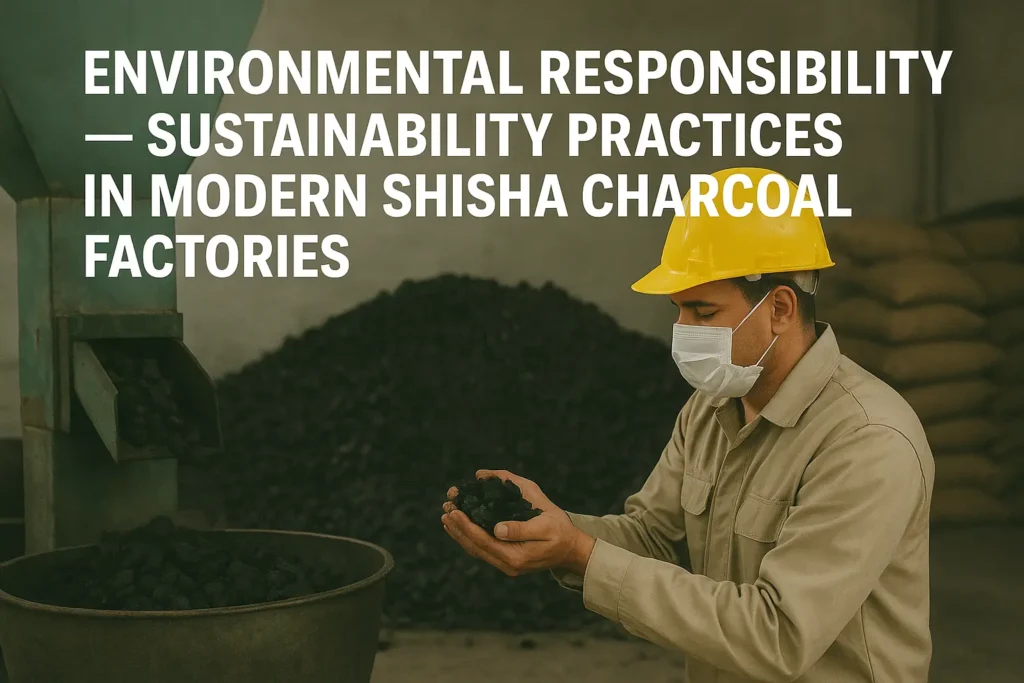
In today’s global market, sustainability is no longer optional — it’s a core expectation.
Buyers, especially from Europe and the Middle East, now demand that every Shisha Charcoal Factory follows environmentally responsible manufacturing methods.
A factory that prioritizes green production not only protects the planet but also enhances your brand reputation in eco-conscious markets.
Let’s explore what defines an environmentally responsible shisha charcoal producer.
🌴 1. Responsible Coconut Shell Sourcing
The foundation of sustainability starts with the raw material.
Premium factories ensure that their coconut shells come from renewable, waste-derived sources — not from deforestation or non-sustainable logging.
In other words, they use discarded coconut shells that would otherwise become agricultural waste.
This transforms waste into value and reduces landfill pollution.
Responsible sourcing practices include:
- Partnering with local coconut farmers
- Using only naturally fallen shells
- Avoiding any use of wood or forest-based materials
- Conducting periodic audits of raw material suppliers
💡 Eco Fact: Each ton of coconut shells repurposed prevents roughly 1.8 tons of CO₂ emissions compared to traditional wood charcoal.
🔥 2. Low-Emission Carbonization Process
The carbonization stage — where shells turn into charcoal — is the most emission-sensitive phase.
A responsible Shisha Charcoal Factory uses modern retort kilns or continuous carbonization systems with gas recycling features.
This technology captures and reuses volatile gases, drastically cutting harmful smoke and emissions.
Green carbonization benefits:
- Up to 70% fewer CO₂ and particulate emissions
- Higher charcoal yield from the same raw material
- Consistent volatile matter control
- Safer working environment for operators
Factories still using open drum kilns often cause environmental harm and inconsistent quality — a clear red flag for importers seeking sustainable suppliers.
♻️ 3. Waste Recycling and Reuse
Sustainability doesn’t stop at production.
Efficient factories recycle their own by-products — including charcoal dust, packaging waste, and water used in processing.
For example, charcoal fines can be reused as input for new briquette batches, reducing waste and material costs.
Common sustainable practices:
- Reusing charcoal powder for re-briquetting
- Water recycling systems for dust suppression
- Using biodegradable or recycled paper for packaging
- Safe storage and disposal of non-reusable waste
💡 Pro tip: Ask your Shisha Charcoal Factory how they handle charcoal waste — responsible reuse indicates high operational maturity.
🌞 4. Renewable Energy Usage
A truly eco-friendly factory looks beyond materials — it also rethinks energy sources.
Top factories are shifting to solar-powered dryers or biomass-fired ovens for drying briquettes, reducing their reliance on fossil fuels.
Benefits of renewable-powered production:
- Lower carbon footprint
- Reduced energy cost per ton
- Improved temperature control for drying
- Stronger appeal to eco-conscious buyers
🌊 5. Pollution Control & Air Filtration
The carbonization process emits gases and particulates that can harm the local environment if not managed.
Modern factories use multi-stage filtration systems, smoke condensers, or bio-scrubbers to purify exhaust before release.
Essential pollution control systems include:
- Smoke filtration through water scrubbers
- Gas recovery and reuse units
- Proper chimney height for dispersion control
- Dust collection units in the briquetting area
These systems not only protect the environment but also ensure a healthier workplace for workers.
🌿 6. Certifications that Prove Sustainability
Claims of eco-friendliness must be supported by valid certifications.
A reliable Shisha Charcoal Factory will have at least one or more environmental credentials recognized by international buyers.
Common certifications include:
- ISO 14001 — Environmental Management System
- FSC — Forest Stewardship Council (for packaging materials)
- SMETA / Sedex — Ethical Trade and Labor Practices
- EcoVadis — Sustainability Rating for Global Supply Chains
If a supplier lacks documentation, you can request sustainability reports or evidence of eco-friendly production audits.
💬 7. Social Impact and Local Empowerment
Sustainability also means supporting local communities.
Factories that hire local workers, offer fair wages, and maintain safe working conditions contribute positively to social sustainability.
In regions like Indonesia, many Shisha Charcoal Factories empower rural communities by:
- Providing steady income for coconut farmers
- Creating jobs for local women in packaging
- Offering skill training and workplace safety programs
Such factories not only supply clean charcoal but also uplift the communities that make it possible.
🌍 8. Global Market Advantage of Eco-Friendly Charcoal
In high-value markets — especially Germany, France, Saudi Arabia, and the UAE — importers increasingly prefer suppliers with proven sustainability credentials.
Eco-friendly charcoal isn’t just ethical — it’s commercially powerful.
Advantages for eco-certified suppliers:
- Easier market access and smoother customs clearance
- Higher brand reputation and premium pricing potential
- Stronger appeal to hookah lounges and BBQ chains emphasizing sustainability
💡 In short: A sustainable Shisha Charcoal Factory doesn’t just make cleaner fuel — it builds long-term trust with global buyers.
🏁 Conclusion: Sustainability Defines the Future
The most reliable Shisha Charcoal Factories go beyond quality and consistency — they take responsibility for their environmental footprint.
By sourcing renewable raw materials, controlling emissions, and adopting cleaner technology, they redefine what it means to be a world-class producer.
For buyers, choosing an environmentally responsible supplier isn’t just a moral choice — it’s a strategic advantage in a market that’s rapidly turning green.
Conclusion: The True Definition of a Reliable Shisha Charcoal Factory
Choosing the right Shisha Charcoal Factory isn’t just about price or packaging — it’s about finding a production partner that consistently delivers quality, safety, and trust.
From raw material sourcing to carbonization, moisture control, ash content, and sustainability, every stage reflects how professional and reliable a factory truly is.
The most dependable factories follow strict quality standards, supported by certifications, modern equipment, and transparent processes.
They understand that customers in Europe, the Middle East, and beyond expect not only good charcoal — but also ethical, eco-friendly, and high-performing products that meet international expectations.
In today’s competitive market, what separates a top-tier Shisha Charcoal Factory from the rest is:
✅ Consistency — Every batch performs the same, from the first cube to the last.
✅ Purity — Low ash, low volatile matter, and odorless combustion.
✅ Responsibility — Environmentally conscious production and fair labor practices.
✅ Reliability — Clear communication, stable supply, and honest collaboration.
At the end of the day, a reliable factory doesn’t just produce charcoal —
it builds long-term partnerships with importers, distributors, and global brands who value integrity and performance above all.
If you’re looking for a Shisha Charcoal Factory that combines premium quality with sustainability and reliability,
🌴 Bintang Briquettes stands as your trusted partner in delivering the finest coconut charcoal for both shisha and BBQ markets worldwide.
✨ Final Takeaway:
The best Shisha Charcoal Factory isn’t defined by the lowest price —
but by its commitment to quality, sustainability, and partnership that lasts.