
Introduction
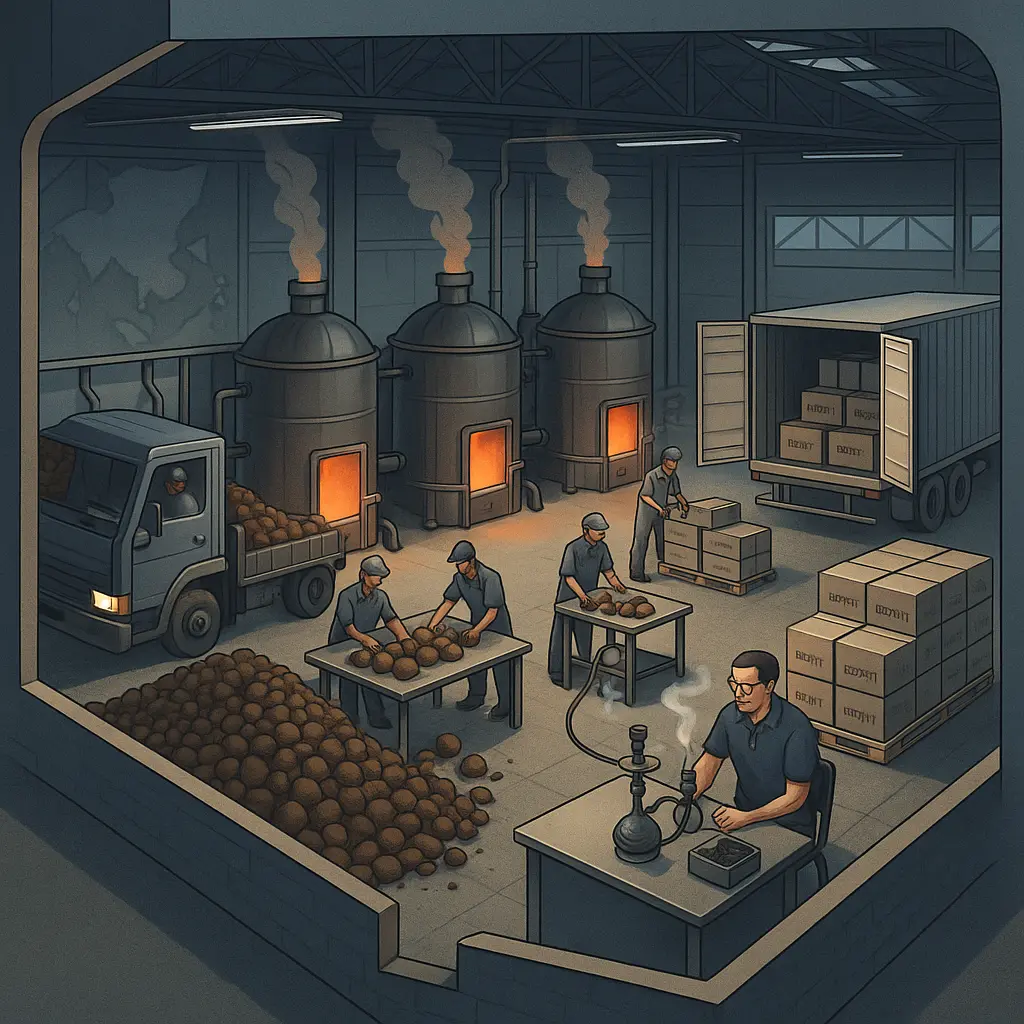
Shisha Charcoal Factory Exposed reveals what many buyers never get the chance to witness. Most importers only see the final product—perfect cubes, clean ash, and strong heat output. Yet the real story happens long before the charcoal reaches a carton.
Inside the factory, every decision influences your final smoking experience. Workers select raw coconut shells, engineers control the carbonization stages, and quality teams test every batch to make sure it meets export standards. These steps decide whether your charcoal will burn evenly, stay firm, or crack during use.
When buyers understand what truly happens behind the scenes, they make better purchasing decisions. They can avoid unreliable suppliers, spot quality manipulation, and choose factories that run consistent and ethical production. This article guides you through those hidden steps—clearly, openly, and without factory sugar-coating.
VISIT US: Indonesian Charcoal Factories: Quality, Pricing, and Export to the Middle East
1. Raw Shell Selection: The Hidden Stage That Determines 70% of Shisha Charcoal Quality
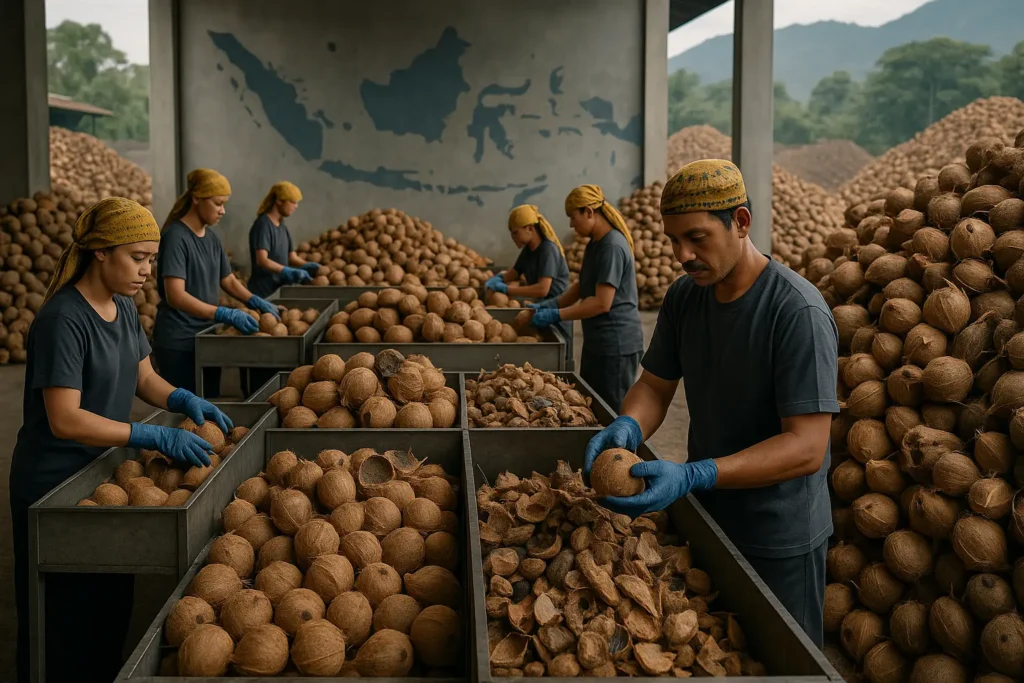
Most buyers think a shisha charcoal factory only starts working once the shells enter the carbonization kiln. But the truth is far more surprising. Before anything becomes charcoal, the factory silently performs one of the most important quality steps—raw coconut shell selection. And in this stage alone, more than 70% of the final charcoal quality is already decided, long before machines take over.
This is exactly why Shisha Charcoal Factory Exposed becomes such an eye-opening topic: the quality customers expect does not start with production—it starts with nature, geography, and strict manual filtering that very few importers ever witness.
Why the Age of Coconut Shell Matters More Than Most Buyers Realize
Not all coconut shells are equal. Factories that chase cheap prices accept anything. But a factory focused on premium shisha coal selects only fully matured shells—usually from coconuts aged 10–14 months. Older shells contain higher lignin levels, which convert into stronger carbon after burning. This leads to:
- Better heat retention
- Longer burning time
- Lower ash production
- More stable cube structure during pressing
Younger shells burn softer and break easily. They might look the same in raw form, but once processed, the briquettes will crack, spark, or collapse under heat.
This hidden detail alone separates a “cheap kiln operation” from a real shisha charcoal factory.
Geographical Difference: Why Shell Origin Changes the Final Briquette Quality
Factories that care about consistency track the origin of every truckload. Shells from Sulawesi, Java, Sumatra, and Kalimantan all behave differently due to soil minerals and coconut varieties.
- Volcanic soil regions: Higher mineral stability → denser charcoal → better cube strength
- High-humidity regions: Shells contain more trapped moisture → more smoke and lower fixed carbon
- Coastal plantations: Slightly saltier soil → affects burn smell and ash color
Premium factories reject shells from unstable sources. This step protects buyers from unpredictable charcoal performance.
Cheaper factories? They buy whatever is available.
This is one of the biggest truths hidden behind the phrase Shisha Charcoal Factory Exposed—geography matters more than machinery.
Three Layers of Shell Filtering That Buyers Almost Never See
A professional factory does not rely on a single sorting step. Instead, they use three layers of filtering:
1. Field-Level Sorting
Workers at the plantation remove shells with fungus, wet husk residues, or excessive fibers. This reduces contamination early.
2. Truck Arrival Sorting
Once shells reach the factory, another team inspects them manually. They measure dryness, size consistency, and contamination level. Anything below standard gets rejected immediately—even if the buyer paid for it.
3. Pre-Carbonization Sorting
Right before entering the kiln, the shells go through the final selection. This is where the factory ensures:
- No soil
- No stones
- No leftover husk
- No high-moisture pieces
- No mixed shell types
This stage protects the kiln from producing unstable carbon that affects fixed carbon, volatile matter, and ash content.
Each of these layers costs time, labor, and money. That’s why premium shisha charcoal has a higher price—quality starts long before charcoal exists.
The Biggest Secret: Cheap Charcoal Begins With Cheap Shells
A factory cannot “fix” low-quality shells with better press machines or fancy mixing formulas. Bad shells turn into bad charcoal, no matter what. This is the uncomfortable reality most buyers never see. When a price looks too cheap, it’s because:
- The factory uses young shells
- They mix multiple shell origins
- They skip filtering rounds
- They use semi-dry shells
- They accept leftover shells from the BBQ charcoal industry
This is why two briquettes can look identical but behave completely differently during a shisha session.
Why This Step Defines the True Identity of a Shisha Charcoal Factory
Raw material control is the moment where every factory reveals its true quality philosophy:
- Premium factory: Rejects more shells than it accepts.
- Standard factory: Accepts shells but relies on later adjustments.
- Cheap factory: Accepts everything, hoping the carbonization will hide the flaws.
In reality, nothing hides flaws in coconut shells. Everything reappears as cracking, inconsistent heat, excessive ash, or a smoky burn.
This is the real reason why understanding Shisha Charcoal Factory Exposed is so important—because the entire story of premium shisha charcoal begins here, quietly, in the raw material yard.
VISIT US: Exposing the Truth About Shisha Charcoal: Myths vs. Facts
2. Carbonization: Where Real Quality Is Made or Destroyed
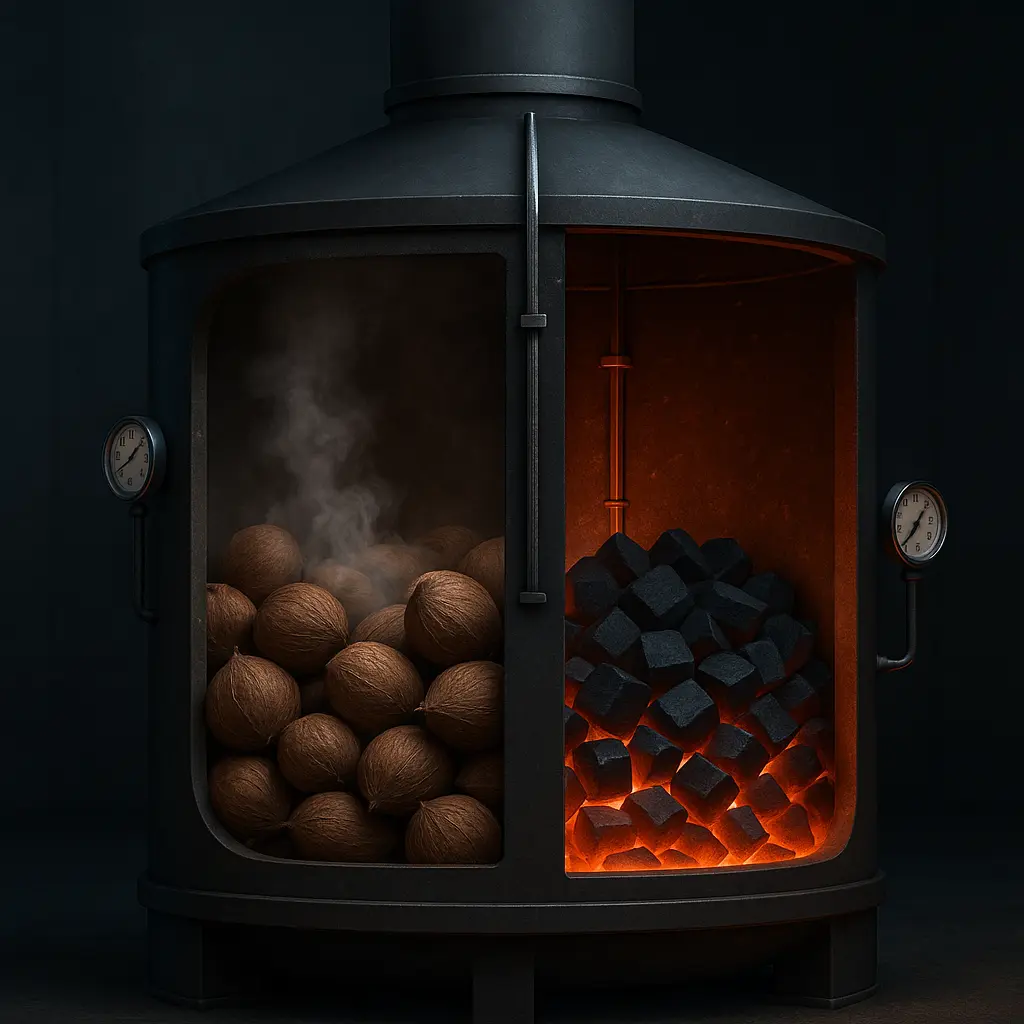
Why Carbonization Is the True Heart of a Shisha Charcoal Factory
Shisha charcoal may look simple, but its performance comes from one process: carbonization. This stage decides whether the charcoal burns clean or creates smoke, whether it stays solid or cracks. A factory can use the best machines, but without proper carbonization control, the final briquette will always fail.
Carbonization transforms raw coconut shells into stable, pure carbon. Factories that rush this step often produce low-grade charcoal with high moisture, acidic odor, and inconsistent heat. Buyers rarely know how different factories handle this step—yet it is the true separator between premium and cheap products.
The Two-Stage Heat Curve That Most Buyers Never Hear About
Top factories never burn shells randomly. They use a two-stage heat curve, a method designed to remove moisture first, then trigger full carbonization.
Stage 1 — Drying at Controlled Low Heat
At this stage, shells are heated at around 150–200°C.
Tujuannya sederhana: menghilangkan air di dalam pori-pori.
Jika pabrik melewati tahap ini terlalu cepat, masalah muncul:
- charcoal smoky
- popping during ignition
- high moisture in final briquette
This is why disciplined factories monitor the process with internal thermometers—not guesswork.
Stage 2 — Full Carbonization at High Heat
After moisture is gone, shells enter 350–450°C.
This is where carbon structure forms.
Factories that push the temperature too high produce brittle charcoal. Factories that keep it too low produce weak carbon with low fixed-carbon percentage.
Premium factories maintain a stable range for hours, ensuring deep, even carbonization.
The Role of Oxygen Control—The Missing Secret
Carbonization is not just about heat; it is also about oxygen.
Top factories seal their kilns carefully. Even a small oxygen leak can:
- cause partial combustion
- reduce charcoal yield
- create acidic smoke odor
- increase ash impurities
Many low-tier factories ignore this, using old kilns with cracked walls. The results? Black charcoal outside, brown charcoal inside—a hidden defect that only appears during burning.
Why Cooling Is a Critical Step (But Often Skipped)
Once carbonization ends, hot charcoal must cool naturally inside the kiln.
Factories that rush cooling by exposing charcoal to open air risk thermal shock. This creates:
- micro-cracks
- explosive popping
- reduced density
Good factories cool for 8–12 hours, and only then transport shells to crushing machines.
What This Means for Buyers
Most suppliers show beautiful videos of their briquettes. Almost none show their carbonization process. Buyers rarely notice that carbon quality determines everything: ash color, heat stability, and burn time.
This is exactly why Shisha Charcoal Factory Exposed gives real insight—because what happens inside the kiln matters far more than the packaging or factory tour.
VISIT US: Why Indonesian Charcoal Is the Preferred Choice of Industry Leaders
3. Carbonization: Where Shells Transform Into High-Quality Charcoal
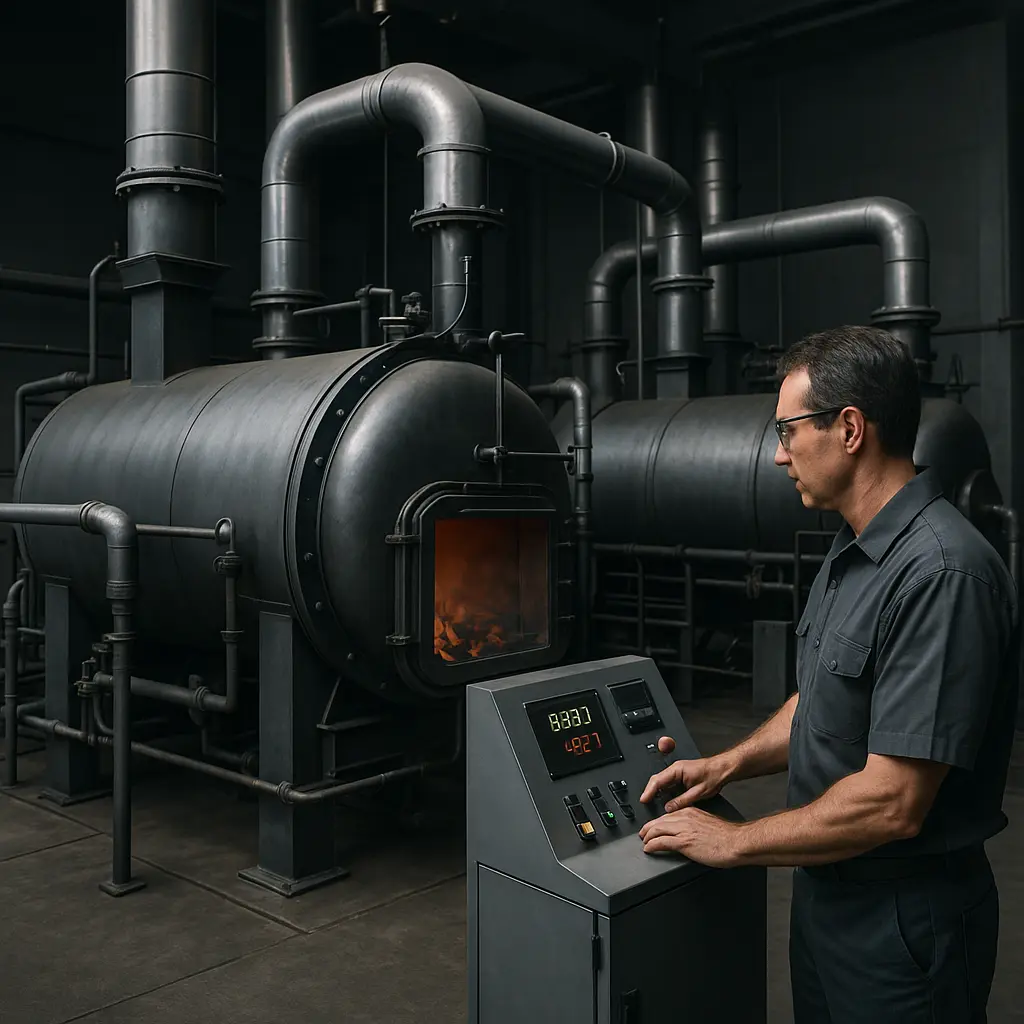
Carbonization is the stage where raw coconut shells finally turn into real charcoal. Buyers often imagine a simple burning process, but a professional shisha charcoal factory uses a much more controlled system. This phase decides almost 70% of the charcoal’s final performance — heat stability, odor level, hardness, and even ash color.
Precise Temperature Control
Good factories use closed kilns or modern retort systems to maintain stable temperatures between 400–600°C. These temperatures strip out moisture, oil, sap, and volatile compounds. If the heat runs too low, the shells turn into weak, crumbly charcoal. If the heat runs too high, the shells burn into ash.
A skilled operator watches the temperature constantly. Small mistakes at this stage ruin entire batches.
Smoke and Gas Management
During heating, shells release heavy smoke and gases. Low-quality factories let these fumes escape into the air, which causes inconsistent burning and leaves chemical residues.
High-end factories use a gas-recirculation system. They burn the smoke back into the kiln, stabilizing heat and reducing emissions. The result is cleaner charcoal with almost no odor.
Slow Cooling for Stronger Structure
After carbonization, operators cool the charcoal slowly inside the kiln. Fast cooling creates cracks. Slow cooling keeps the structure dense and stable, which improves heat duration and reduces breakage during handling.
Most buyers don’t realize how much this small detail affects the end product.
Why This Stage Is Often Hidden
Carbonization is messy, hot, and technical. This is why factories rarely show it to buyers. But this step forms the “backbone quality” of every shisha briquette. Every mistake made here will show up later — in heat loss, sparks, smoke, or breakage.
The truth is simple: a shisha charcoal factory that controls carbonization controls the final quality. And this is one of the biggest hidden steps that typical buyers never see.
VISIT US: Coconut Charcoal Exporter in Indonesia: Reliable Supply with Consistent Quality
4. The Real-World Testing Stage: Where True Quality Survives or Fails
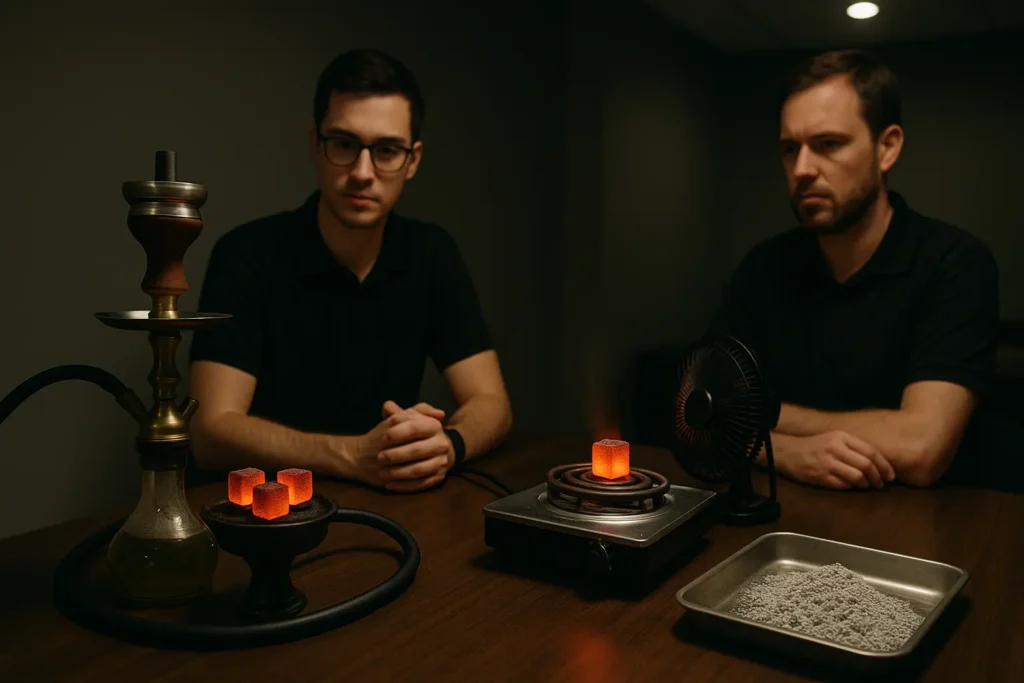
Shisha charcoal factories love to show their machines, their packing rooms, and their warehouse walls lined with cartons. But the part buyers truly need to see is often hidden behind a closed room: the real-world testing area. This is the place where charcoal is not judged by theory, but by fire, heat, and time.
Below are the real tests that reveal whether a briquette is truly premium — or only looks premium on paper.
4.1 Heat Stability Test: Can the Briquette Hold Its Strength?
A high-quality shisha briquette should stay solid under extreme heat.
Factories perform heat stability tests by placing briquettes directly in a controlled burner. Workers then check:
- does the briquette keep its shape?
- does it expand or break?
- does it start cracking after 10–15 minutes of strong heat?
Low-grade briquettes usually collapse early. They look perfect when cold, but the moment they touch heat, they crumble like dry soil.
This test exposes the real build quality of the charcoal, not just its chemistry.
4.2 Real Hookah Session Test: The Only Test That Truly Matters
No lab test can replace an actual hookah session.
Top factories ignite three cubes and run them in a bowl with real tobacco molasses. They observe:
- heat flow
- smoke smoothness
- flavor purity
- duration of the burn
- whether the briquettes overheat the bowl
Buyers rarely see this test, yet this is the stage that separates “factory charcoal” from “lounge charcoal.”
If a briquette cannot deliver clean heat without altering flavor, it fails — no matter how beautiful the packaging is.
4.3 Wind Consistency Test: Can It Maintain Heat in Outdoor Conditions?
This test simulates conditions in outdoor cafés or beach lounges, where wind often disrupts heat control.
Factories blow controlled air toward burning briquettes to check:
- how fast the heat drops
- whether ash blows off too easily
- if the briquettes start cracking from temperature shocks
High-quality briquettes resist sudden changes.
Low-quality briquettes lose temperature fast, forcing smokers to replace charcoal every 20–25 minutes.
4.4 Ash Color & Texture Test: The Silent Indicator of Factory Quality
Even though customers rarely think about ash, factories rely on ash behavior to evaluate production consistency.
The best shisha charcoal factories expect:
- silver-white ash
- uniform texture
- soft-fine particles, not large flakes
Dark ash or yellow ash signals impurities, unstable carbonization, or contaminated raw shells.
This test reveals whether the entire batch maintains consistent standards.
4.5 Durability Test: How Long Will It Last for Customers?
A premium briquette should last 90 minutes or more depending on cube size.
Factories simulate a full hookah session to measure:
- exact burn time per cube
- burn curve from ignition to final ash
- temperature stability across the whole duration
Importers depend heavily on this test because burn duration directly affects customer satisfaction — and cost efficiency for lounges.
Why This Stage Is Often Hidden from Buyers
Real-world testing exposes a factory’s true capability.
Factories with weak quality control prefer to skip or shorten this stage because:
- failed batches must be reprocessed
- charcoal waste increases
- production time becomes longer
- total cost of manufacturing rises
Top factories, however, invest heavily in these tests. They know that this stage determines their reputation and keeps long-term buyers loyal.
This is why the article is titled Shisha Charcoal Factory Exposed — because most buyers never see these critical tests, yet these are the steps that reveal whether a briquette is truly world-class.
VISIT US: Exporting Charcoal Briquettes from Indonesia: Premium Quality for Various Industries
5. Final Quality Gate: The Hidden Inspection Wall Before Export

The last stage inside a shisha charcoal factory looks simple from the outside. Buyers often imagine workers only counting boxes and loading containers. In reality, this stage is the most guarded checkpoint, and it decides whether a batch reaches the market or gets rejected. This is the moment where Shisha Charcoal Factory Exposed becomes real—because this is where many factories quietly fail.
A premium factory uses three layers of inspection before the briquettes leave the warehouse:
5.1. Mechanical Consistency Check
The first check focuses on physical strength. Workers test random briquettes from every batch by applying controlled pressure. If the briquettes break too easily, it means poor carbon density or improper curing. A weak briquette may survive packaging, but it will not survive the heat of a shisha session. This early rejection saves buyers from customer complaints and product returns.
5.2. Thermal Performance Verification
Next, a small burn test takes place. Real factories keep dedicated burn stations where selected briquettes are lit and evaluated for:
- heat stability
- burn duration
- ash formation speed
- odor release under high heat
Cheaper factories skip this step because it consumes product and takes extra time. But serious manufacturers treat it as mandatory. A burn anomaly detected here can signal deeper issues in carbonization, humidity control, or mixing ratios.
5.3. Packaging Integrity Review
Even the best briquette can fail if the packaging is weak. Moisture in the warehouse or container can ruin entire pallets. That’s why high-level factories check:
- inner box lining quality
- carton pressure resistance
- sealing strength
- pallet wrapping stability
- barcode traceability
A single tear in shrink wrap can increase moisture by 2–4%, enough to downgrade the briquettes from premium to reject quality.
5.4. Batch Traceability and Final Approval
Before shipping, every batch receives a tracking code linked to:
- raw material origin
- kiln batch number
- production date
- lab test results
- burn-test score
This system allows buyers to track any issue back to the exact production stage. Many factories avoid this because it exposes mistakes, but professional factories embrace it to maintain long-term trust.
5.5. The Real Final Question Buyers Never Ask
Yet this final gate shows the factory’s true character.
A factory that willingly rejects its own product is a factory that protects your business.
This is the part of Shisha Charcoal Factory Exposed that matters most:
quality is not defined by production — it’s defined by what the factory refuses to ship.
VISIT US: Premium Shisha Charcoal in Iraq: Strong, Reliable, and Made for Performance
Conclusion
The deeper you look inside a production line, the clearer the truth becomes: premium shisha charcoal isn’t created by chance. It comes from strict material selection, precise carbonization, controlled mixing, advanced pressing systems, and continuous quality checks. Many buyers only see the final briquettes in boxes, but the real quality is made long before shipping—even before the shells enter the kiln.
Shisha Charcoal Factory Exposed reveals one important message: reliability comes from factories that treat every step as a critical stage, not a routine task. When a supplier protects consistency, transparency, and technical accuracy, the charcoal will always reflect that commitment.
If importers want long-term success, they must look beyond price lists and packaging. They must understand how each hidden process shapes heat strength, ash color, hardness, burning time, and customer satisfaction. When you choose the right factory, you’re not just buying charcoal—you’re securing stable supply, predictable performance, and a partner who supports the future of your business.